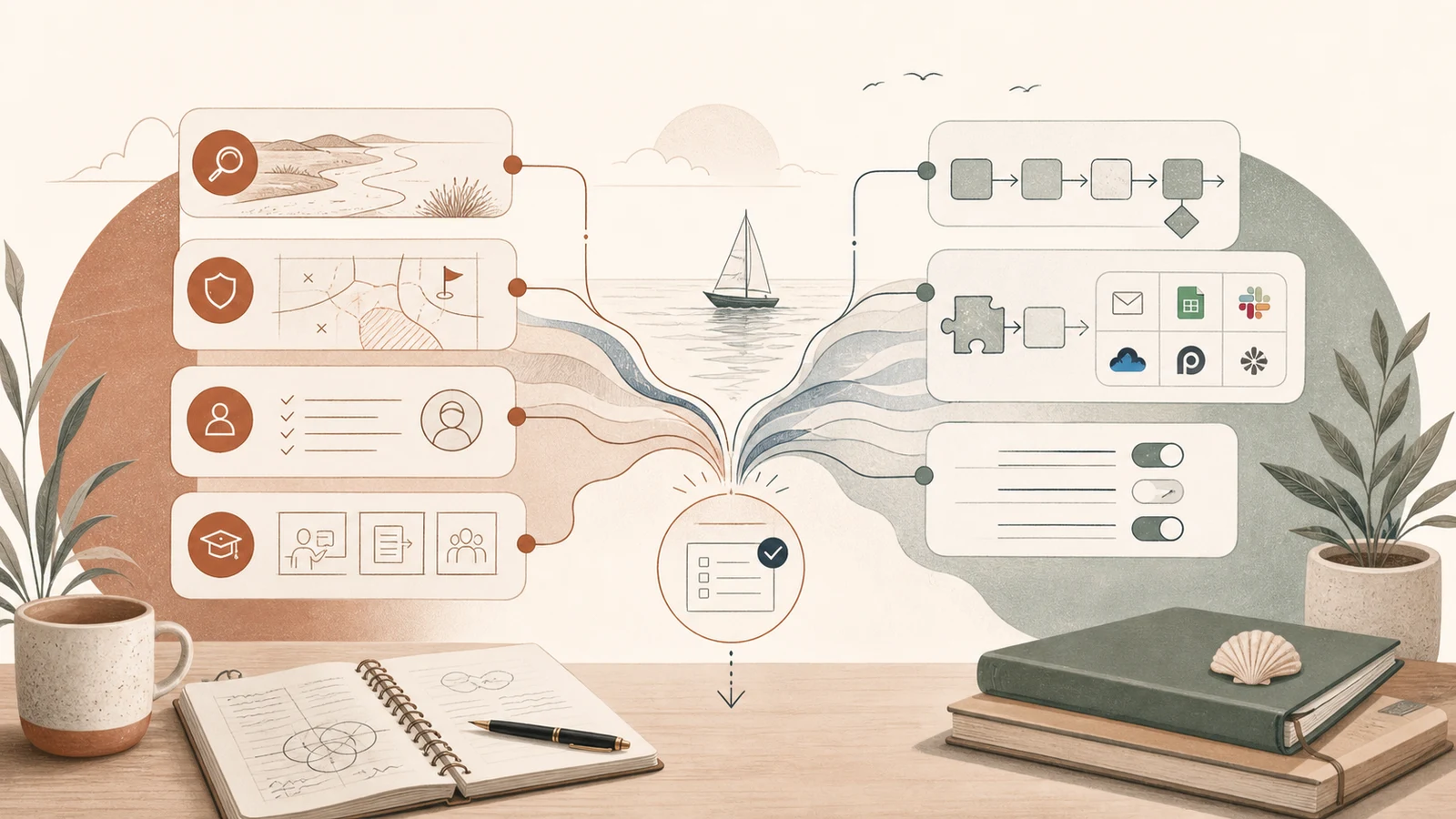
Hire an AI consultant first when you are still deciding what AI should do in the business. Hire an automation agency when the workflow is already clear, repeated, valuable, and ready to connect into systems.
AI consultants and automation agencies can both be useful.
The mistake is hiring the wrong one at the wrong stage.
If you do not know which workflow should come first, automation can become an expensive way to make a messy process faster. If you already have a proven workflow, staying in strategy mode for too long can slow you down.
The better question is: what stage are you actually at?
Start with the work, not the vendor
Before comparing providers, map the work.
Ask:
- What task happens every week?
- Who starts it?
- What information goes in?
- What decision is being made?
- What does a good output look like?
- Who checks it?
- What happens when it is wrong?
- Which tools or systems are involved?
If these answers are fuzzy, you probably need consulting before automation.
If these answers are clear, you may be ready for implementation or automation.
What an AI consultant is best for
An AI consultant helps you decide where AI fits and how to adopt it safely.
Good AI consulting usually includes:
- Finding high-value workflows.
- Choosing the right first use case.
- Comparing AI tools against the actual work.
- Designing prompts, instructions, and review steps.
- Training staff.
- Setting privacy and quality boundaries.
- Helping leaders avoid hype-driven spending.
For an established business, this is useful when AI still feels broad, confusing, or risky.
Rising Tide’s AI consulting work is built around this stage: assess the work first, then choose the next step.
What an automation agency is best for
An automation agency helps connect systems and reduce manual handoffs.
This can include:
- Moving data between tools.
- Triggering actions from forms, emails, CRMs, or spreadsheets.
- Building repeatable workflows in automation platforms.
- Connecting APIs.
- Reducing manual copying and updating.
- Creating dashboards or notifications.
Automation is powerful when the underlying process is already understood.
It is risky when the business is still guessing what the process should be.
The simplest rule
Use this rule:
- Unclear workflow: hire an AI consultant.
- Clear workflow: hire someone to set it up.
- Proven workflow: consider automation.
- High-risk workflow: keep human review in the loop.
This keeps the project grounded.
When to start with an AI consultant
Start with an AI consultant if:
- You are not sure where AI would save time.
- The team has tried AI, but usage is inconsistent.
- Staff are using ChatGPT or Claude without shared rules.
- You are worried about privacy, quality, or client trust.
- You want help choosing the first workflow.
- You need training before automation.
- The process currently lives in people’s heads.
In this stage, a good first outcome is not a complex build.
It is a short list of workflows ranked by value, risk, and ease of adoption.
When to hire an automation agency
Hire an automation agency when:
- The workflow is already repeated and documented.
- The inputs and outputs are predictable.
- The team agrees on the review process.
- The workflow has been tested manually.
- The business knows which systems need to connect.
- The benefit is large enough to justify setup and maintenance.
At that point, automation can reduce busywork and make the process more consistent.
The risk of automating too early
Early automation often fails for boring reasons:
- Nobody agrees what the workflow should do.
- The source information is messy.
- Exceptions are more common than expected.
- Staff do not trust the output.
- The AI is asked to make decisions it should only support.
- Nobody owns maintenance when tools change.
The result is a workflow that looks clever in a demo but does not survive normal work.
This is why AI automation should usually begin with a small, reviewable workflow.
A practical sequence for established teams
For most established business teams, the sequence should look like this:
- Assess the business and repeated work.
- Choose one workflow.
- Create the AI-assisted version.
- Train the team.
- Measure whether it is used.
- Improve the instructions and review steps.
- Automate deeper only if the workflow is proven.
This gives you momentum without gambling on a large system too early.
Where Claude and ChatGPT fit
Many businesses do not need a custom AI system first.
They need Claude, ChatGPT, or another tool set up properly around their work.
That can include:
- Project instructions.
- Reusable prompts.
- Knowledge files.
- Team rules.
- Review checklists.
- Examples of good outputs.
Those pieces can save time before any system integration is needed.
Questions to ask both types of provider
Whether you speak with an AI consultant or automation agency, ask:
- What should we not automate yet?
- How will you choose the first workflow?
- How will staff review the output?
- What happens when the AI is wrong?
- Which tool choices are reversible?
- What maintenance will this need?
- How will we know whether it worked?
The best providers will be comfortable slowing down a bad idea.
The Rising Tide view
If you already have a clear, proven workflow, automation may be the right move.
If you are still deciding what AI should do, start with consulting.
For most established Sunshine Coast service businesses, the sensible first step is an AI readiness assessment, followed by one AI workflow setup and practical team training.
That gives you a working first use case before you spend heavily on automation.