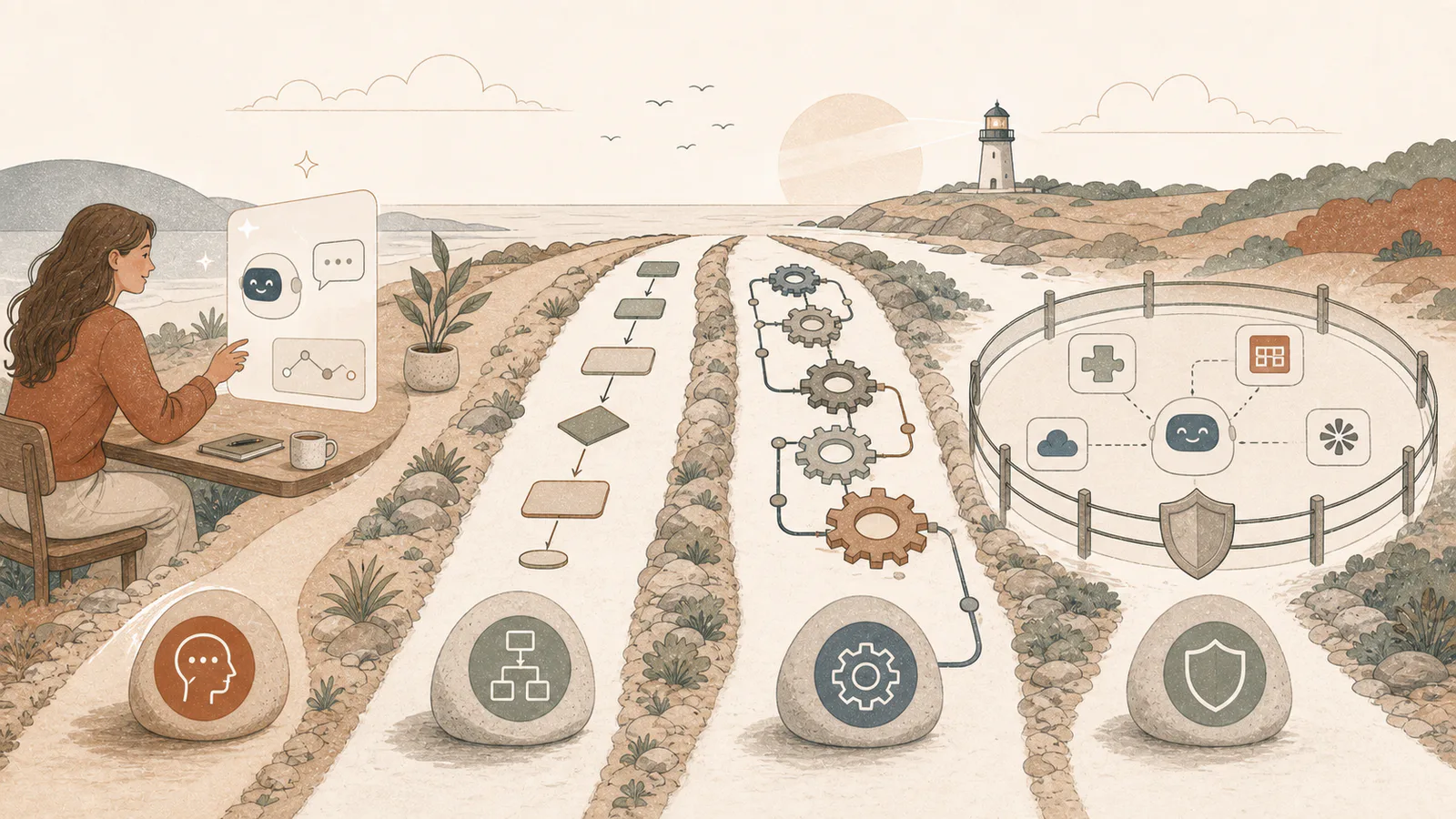
Use a fixed workflow when you know the steps. Use traditional automation when clear rules can move information or trigger actions. Use an AI agent only when the path genuinely varies and the system needs bounded judgement to choose what to do next.
“Agent” is becoming the default label for almost every AI feature.
That makes buying and planning harder.
The useful question is not whether a product calls itself agentic. It is how much freedom the system has to decide, act, and access.
AI assistant
An assistant responds to a person.
Examples:
- Draft an email.
- Summarise a document.
- Suggest a meeting agenda.
- Explain a spreadsheet.
The person starts the task, supplies context, and decides what happens next.
This is often the best first stage because control remains visible.
AI workflow
An AI workflow follows a sequence designed in advance.
For example:
- Receive meeting notes.
- Extract decisions and actions.
- Format them in a template.
- Ask a person to approve.
- Send the approved actions to the project system.
AI may interpret the notes, but the route through the process is fixed.
Anthropic’s guide to building effective agents makes the same useful distinction: workflows have predefined orchestration, while agents dynamically direct their own process and tool use.
Traditional automation
Traditional automation performs predictable steps using rules.
Examples:
- When a form is submitted, create a CRM contact.
- If an invoice is overdue, send a reminder.
- Copy an approved field from one system to another.
- Rename and file documents using known values.
It is excellent when the condition and action can be stated precisely.
Do not replace a reliable rule with an AI decision just because AI is available.
AI agent
An agent is given a goal, tools, and boundaries, then chooses some of the steps required to complete the task.
For example, a bounded research agent might:
- Search approved sources.
- Decide which pages are relevant.
- Extract evidence.
- Compare conflicting statements.
- Ask for missing information.
- Produce a draft with citations.
OpenAI’s practical guide to building agents describes the core components as a model, tools, and instructions. The defining issue for a business is the agent’s authority: what it can see, decide, change, send, buy, or delete.
A simple comparison
| Approach | Path | Best for | Main risk |
|---|---|---|---|
| Assistant | Chosen by person | Drafting and analysis | Unchecked output |
| Workflow | Predefined | Repeated multi-step work | Bad process design |
| Automation | Rule-based | Predictable system actions | Incorrect rules or integrations |
| Agent | Chosen dynamically within bounds | Variable, judgement-heavy tasks | Excess authority or unpredictable action |
Choose the least autonomy that works
Use this order:
- Can a template solve it?
- Can a person use an AI assistant?
- Can a fixed workflow solve it?
- Can deterministic automation handle the action?
- Does the task truly need an agent to choose among possible paths?
Each step adds capability and operating responsibility.
When an agent may be justified
An agent becomes more useful when:
- Inputs are unstructured.
- Cases vary substantially.
- The rules would be too numerous or brittle.
- Several tools may be needed in different combinations.
- The task can be evaluated and bounded.
- A human can take over when needed.
An agent is a poor fit when the action is irreversible, the evidence cannot be checked, permissions cannot be limited, or nobody owns monitoring.
Questions vendors should answer
- Which decisions are made by rules and which by the model?
- What tools and data can the agent access?
- Can permissions be limited by task and user?
- Which actions require approval?
- How are instructions from untrusted files or websites handled?
- Are actions logged and reversible?
- What happens after repeated failure?
- How is performance tested after changes?
If the answers are vague, the system is not ready for important work.
Start with a bounded workflow
Before giving an agent broad access, prove the task with a fixed, reviewable process.
The first AI workflow should be small enough to inspect and valuable enough to measure. Rising Tide’s AI automation support starts with the workflow and permissions before choosing how autonomous the system should become.