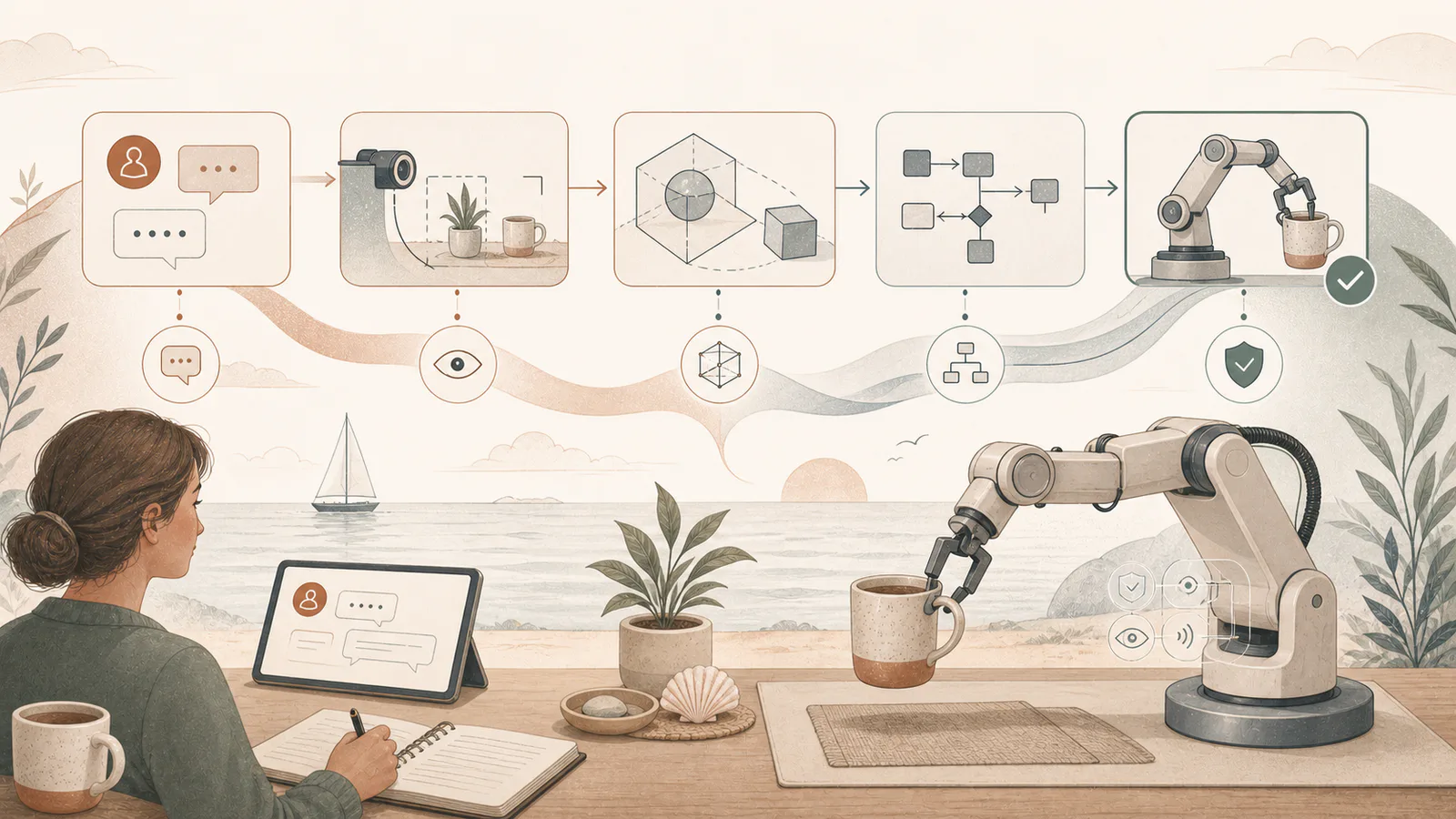
Embodied AI connects an AI system to sensors and physical action. Instead of only producing text or images, it can perceive an environment, plan a task, and control a robot or machine—within the limits of its hardware, training, and safety systems.
A chatbot can suggest how to sort a set of objects.
An embodied AI system must see the objects, understand their position, choose a grasp, move safely, notice failure, and try an appropriate recovery.
The physical world makes the problem harder and the consequences more concrete.
The parts of an embodied AI system
Perception
Cameras, depth sensors, force sensors, microphones, lidar, or other inputs describe the environment.
World understanding
The system identifies objects, people, spaces, conditions, and relationships.
Planning and reasoning
It selects steps that might achieve the task while respecting constraints.
Action
Motors, grippers, wheels, tools, or other actuators change the physical environment.
Feedback
The system observes what happened, detects success or failure, and adjusts.
How it differs from traditional robotics
Traditional industrial robots are often excellent at a fixed, carefully engineered task in a controlled workcell.
Embodied AI aims to add more flexible perception, language understanding, planning, or adaptation.
That may help a robot:
- Work with more varied objects.
- Follow natural-language instructions.
- Adapt to changes in a workspace.
- Use digital tools while planning a physical task.
- Generalise from demonstrations.
Flexibility is valuable, but it is not the same as guaranteed reliability.
Vision-language-action models
One important research direction is the vision-language-action model.
It receives visual information and language instructions, then produces actions for a robot.
Google DeepMind describes Gemini Robotics as a vision-language-action system designed to support generality, interactivity, and dexterity across different robot forms. Its separate embodied-reasoning models focus on spatial understanding, planning, and tool use.
These systems show why AI and robotics are converging. They do not mean every workplace is ready for a general-purpose robot.
Physical action changes the risk
A wrong paragraph can be edited.
A wrong physical action can:
- Damage an object.
- Injure a person.
- Contaminate a process.
- Block an aisle.
- Stop production.
- Create a difficult recovery.
Safety cannot depend only on the AI model behaving well.
Robotic systems use layers such as mechanical limits, guarded zones, force limits, collision avoidance, emergency stops, safe controllers, operator procedures, and task-specific risk assessment.
DeepMind’s robotics safety work describes a layered approach across semantic, physical, and operational safeguards. The broader lesson is sound: no single layer is sufficient.
Evaluate the environment, not only the robot
Ask:
- How variable are the objects and workspace?
- Are people nearby?
- What forces, speeds, tools, or loads are involved?
- What counts as success?
- How is failure detected?
- Can a person intervene safely?
- What happens during network, sensor, model, or power failure?
- Who maintains the system?
A capable robot in the wrong environment is a poor solution.
Where embodied AI may create value
Good early opportunities are often tasks that are:
- Repeated.
- Physically tiring or hazardous.
- Measurable.
- Bounded to a known environment.
- Difficult for rigid automation because of some variation.
- Supported by safe human supervision.
Examples include visual inspection, materials handling, picking, cleaning, agricultural monitoring, and structured maintenance support.
Avoid the humanoid shortcut
Humanoid robots attract attention because they fit spaces and tools designed for people.
But the business question is not “When can we buy a humanoid?”
It is:
Which physical task has enough value, repetition, safety improvement, and measurable success to justify robotics?
The best form may be a fixed camera, mobile platform, robotic arm, cobot, drone, or specialised machine.
Start with task evidence
Map the physical workflow, variability, risk, labour, downtime, and exceptions before choosing hardware.
The same principle used in AI assessment before automation applies to robotics: start with the work. Rising Tide’s AI consulting can help businesses understand where digital AI ends and a physical automation opportunity begins.