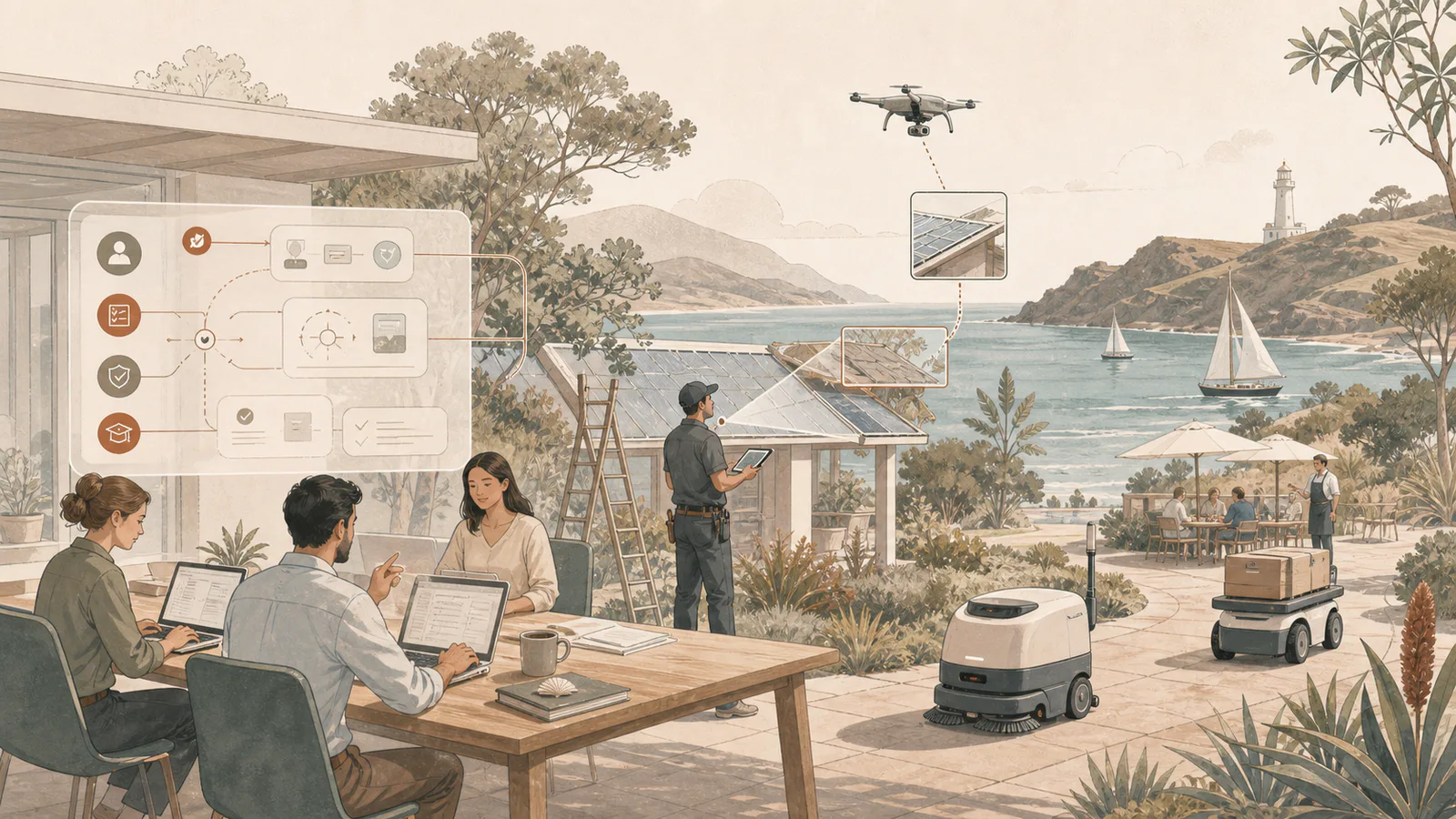
Service businesses will usually gain value from digital AI first: enquiries, documents, scheduling, reporting, knowledge, and follow-up. Robotics becomes relevant where physical inspection, monitoring, cleaning, logistics, or hazardous repeated work can be bounded and measured.
Robotics conversations often begin with a humanoid demonstration.
Most service-business opportunities will begin somewhere less dramatic.
A camera checks an asset. A drone surveys a roof. A cleaning robot covers a predictable floor. A mobile platform moves material. AI turns field notes into a report and schedules the next action.
The value comes from the workflow, not the shape of the machine.
Digital AI comes first for most teams
Common service-business opportunities include:
- Drafting and triaging enquiries.
- Extracting information from documents.
- Preparing quotes and proposal outlines.
- Turning calls and meetings into actions.
- Searching internal knowledge.
- Scheduling and dispatch support.
- Drafting reports from approved evidence.
- Checking job completeness.
These workflows are cheaper and easier to test than physical automation. They also create cleaner information for future robotics.
Machine vision extends AI into the field
Before a robot acts, a camera or sensor may create value by:
- Detecting defects.
- Reading gauges or labels.
- Comparing before-and-after condition.
- Counting stock or equipment.
- Monitoring restricted areas.
- Verifying that a step was completed.
The output may go to a person first. Physical action is not required on day one.
Drones and remote inspection
For suitable regulated use, drones or remote devices can help inspect:
- Roofs and solar installations.
- Construction progress.
- Agricultural areas.
- Difficult terrain.
- Large facilities.
- Assets that are unsafe or costly to access.
AI can organise imagery, identify areas for review, and draft evidence-linked reports. Qualified people remain responsible for the conclusion and regulatory compliance.
Cleaning and routine facility work
Professional service robots are already concentrated in practical categories such as transportation, logistics, cleaning, and hospitality.
The International Federation of Robotics reported almost 200,000 professional service robots sold in 2024, with transportation and logistics the largest application class in its World Robotics 2025 release.
This shows where structured physical tasks are creating demand today.
Materials and equipment movement
Mobile robots can move linen, stock, tools, waste, parts, or supplies within a mapped environment.
Good candidates have:
- Repeated routes.
- Predictable handoff points.
- Enough volume.
- Suitable floors and access.
- Clear interaction with people and vehicles.
- A manual fallback.
Doorways, lifts, clutter, weather, and peak traffic can determine whether the workflow works.
Specialist robotic tools
Service businesses may encounter:
- Robotic inspection crawlers.
- Pipe or tank inspection devices.
- Remote manipulators.
- Exoskeletons or lifting assistance.
- Automated mowing or vegetation tools.
- Agricultural robots.
- Cobots supporting workshops or fabrication.
Specialised form often beats a general-purpose humanoid because it is designed around the environment and task.
Connect digital and physical workflows carefully
An end-to-end system might:
- Receive a service request.
- Check asset history.
- Schedule inspection.
- Collect images or sensor data.
- Flag anomalies.
- Ask a technician to confirm.
- Draft a report.
- Create approved follow-up work.
Each step needs its own evidence, permissions, failure handling, and human oversight.
Do not grant broad system access merely because the robot or agent can technically use it.
What will remain human
People will continue to provide:
- Customer trust and explanation.
- Judgement in unusual environments.
- Responsibility for consequential decisions.
- Skilled physical improvisation.
- Safety supervision.
- Relationship and conflict handling.
- Repair and recovery.
- Workflow design and improvement.
The aim is to remove avoidable load, not pretend the work has no human context.
A readiness sequence
- Improve the digital information flow.
- Identify a bounded visual or physical task.
- Measure current cost, quality, risk, and variation.
- Test machine vision or decision support without automatic action.
- Pilot specialised robotics where justified.
- Connect systems only after both sides work reliably.
- Expand autonomy gradually.
Google DeepMind’s embodied AI research demonstrates the direction: models that perceive, reason, use tools, and interact with the physical world. The business response should be curiosity with disciplined task selection.
Begin with what embodied AI means and assess the robotics opportunity before choosing hardware. Rising Tide’s AI assessment can identify whether the next useful step is digital AI, machine vision, specialist automation, or simply a better process.