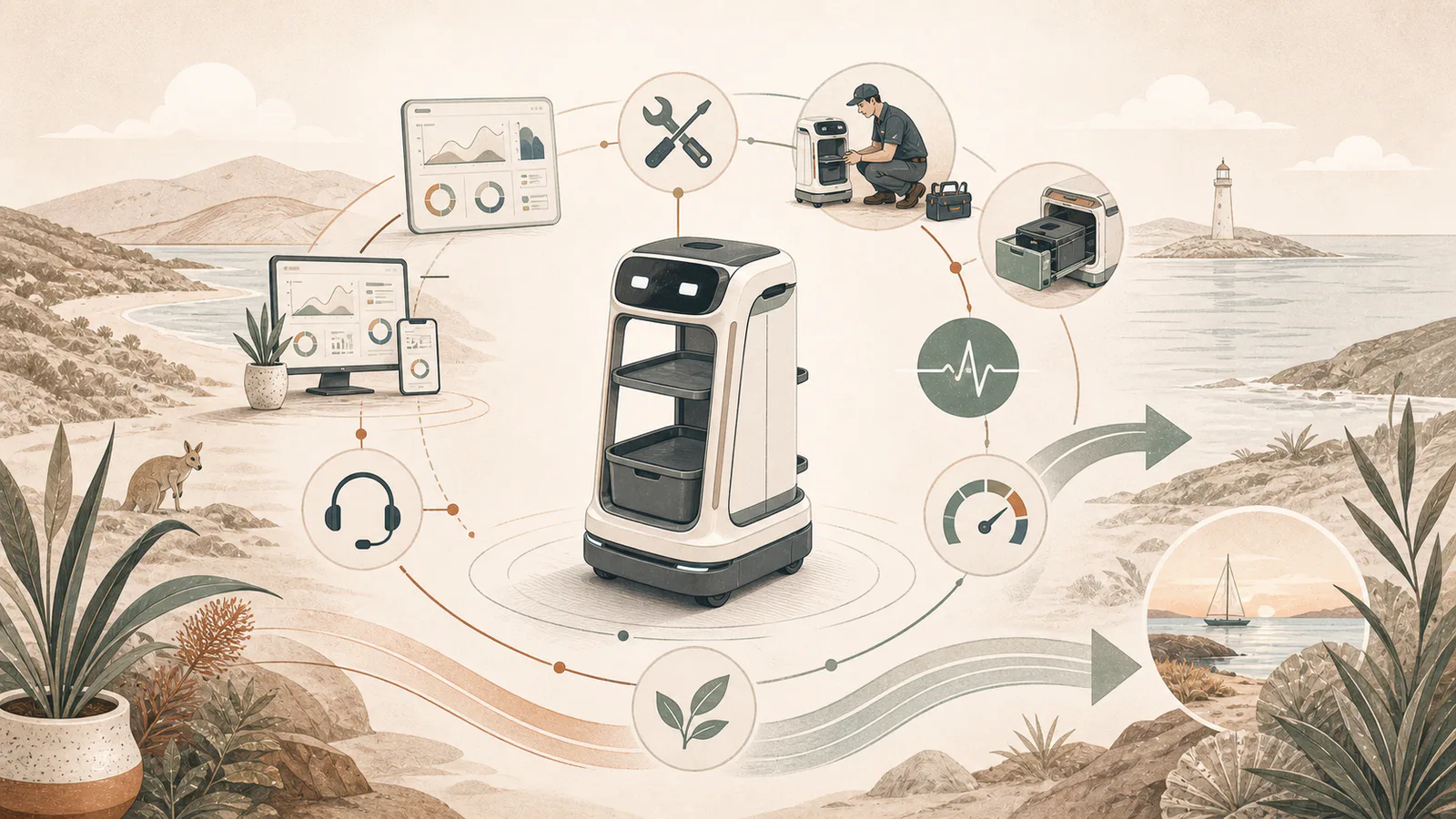
Robotics as a service provides robotic capability through a subscription, rental, or usage model. It can lower upfront cost and bundle support, but it does not remove the need to prove the workflow, assess safety, integrate the site, and manage performance.
Buying a robot outright is not the only way to adopt physical automation.
Robotics as a service—often shortened to RaaS—shifts some cost and operating responsibility into an ongoing service arrangement.
That can make a pilot easier. It can also hide a weak business case inside an attractive monthly price.
What a RaaS offer may include
- Robot hardware.
- Software and remote monitoring.
- Installation or configuration.
- Preventive maintenance.
- Repairs and replacement.
- Performance reporting.
- Support and training.
- Updates or new capabilities.
The bundle varies. Read the scope carefully.
Why businesses consider it
Lower upfront capital
The business may avoid a large purchase and spread cost across operations.
Faster pilot
A provider with a proven package may deploy more quickly than a custom purchase and integration project.
Maintenance support
Specialist maintenance and remote monitoring may be included.
Flexibility
Some contracts allow capacity, device, or term changes as the workflow develops.
Shared performance incentive
Usage or outcome-based pricing can align the provider with the robot actually working.
The market is moving this way
The International Federation of Robotics reported that the global professional service-robot RaaS fleet grew by 31% in its World Robotics 2025 service robot release. It identified subscription and rental as ways organisations are adopting automation without the same upfront investment.
That trend supports availability. It does not prove fit for a particular site.
Start with the workflow economics
Measure:
- Current labour and supervision.
- Volume and peak demand.
- Task time and waiting.
- Error, rework, or damage.
- Injury or ergonomic exposure.
- Downtime impact.
- Site preparation.
- Human work that remains.
Compare the full current process with the full RaaS process.
Ask what happens outside the happy path
- Who moves the robot when access is blocked?
- What happens with unusual objects or layouts?
- Who cleans, charges, resets, or replenishes it?
- How are failures detected?
- How quickly does support respond?
- Is a replacement available?
- What manual fallback keeps work moving?
A robot can create a new job around managing exceptions.
Contract around measurable performance
Useful measures may include:
- Uptime during required hours.
- Tasks completed.
- Accuracy or defect rate.
- Intervention rate.
- Response and repair time.
- Safety events.
- Energy or consumable use.
- Coverage of the agreed site or process.
Avoid a service level based only on whether the device turns on.
Clarify safety responsibility
The provider may supply hardware and maintenance, while the customer controls the site, staff, traffic, task, and operating conditions.
Define responsibility for:
- Risk assessment.
- Site induction.
- Changes to layout or task.
- Incident reporting.
- Emergency procedures.
- Operator training.
- Maintenance isolation.
- Regulatory and insurance requirements.
Obtain competent safety advice for the application.
Understand data and cyber security
Connected robots may collect:
- Video or sensor data.
- Facility maps.
- Production or utilisation data.
- Operator interactions.
- Error logs.
- Location and movement.
Ask where the data goes, who can access it, how remote support connects, how software is updated, what happens during a cyber incident, and what data is returned or deleted at exit.
Model the full contract term
Include:
- Subscription or usage fees.
- Minimum volumes.
- Deployment and site work.
- Integrations.
- Consumables.
- Staff supervision.
- Training and retraining.
- Price increases.
- Change requests.
- Termination and removal.
Compare this with purchase, lease, outsourcing, process redesign, and doing nothing.
Pilot before scaling
Choose one bounded task, site, or shift. Set performance and stop criteria. Keep a manual fallback and record interventions.
If the pilot works, expand from evidence rather than contract enthusiasm.
Read cobots versus industrial robots and how to test an AI workflow—the same discipline applies to physical automation. Rising Tide’s AI consulting can help establish whether a robotics opportunity is ready for specialist vendor evaluation.