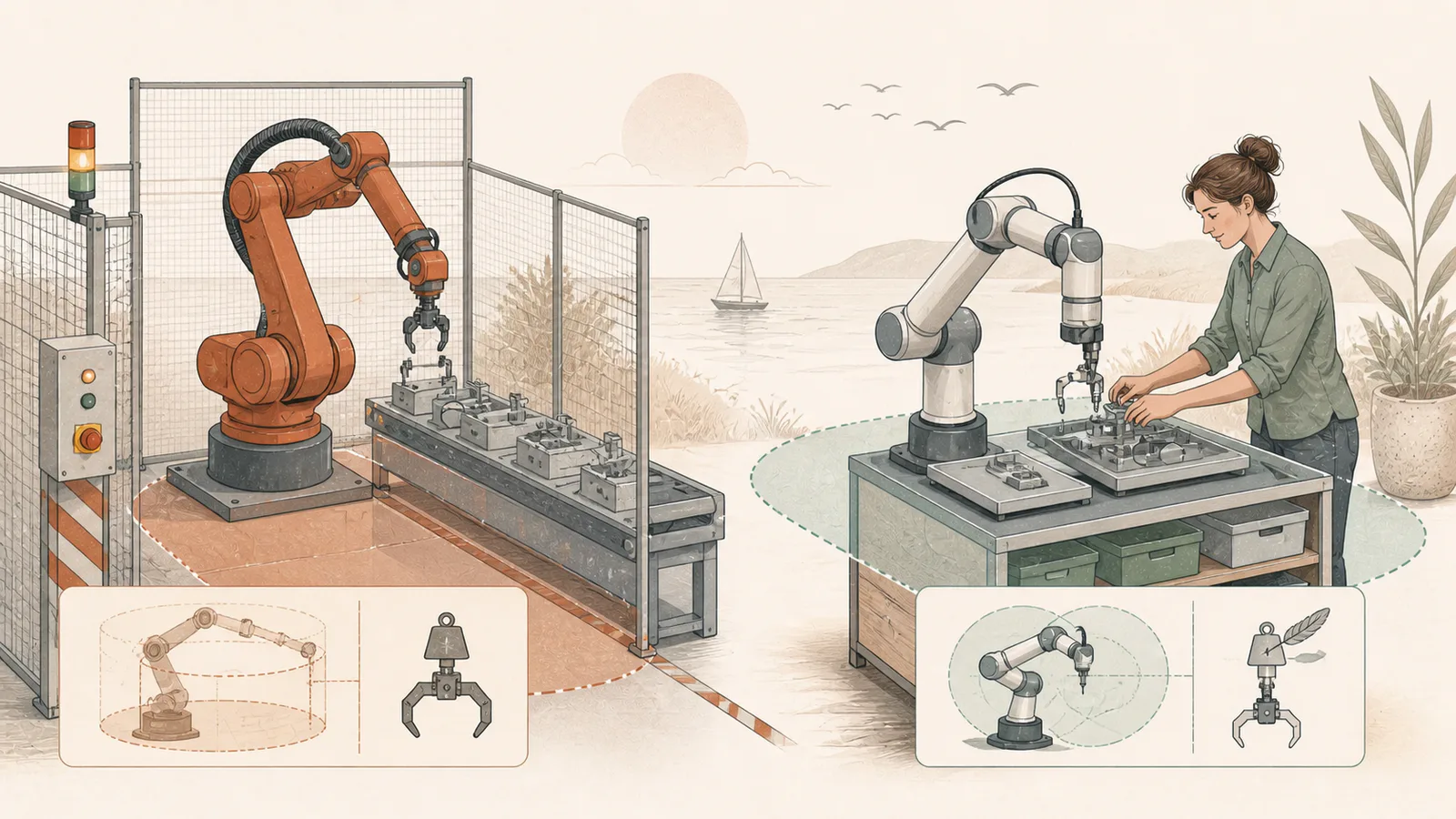
Choose a traditional industrial robot for stable, fast, heavy, or highly repetitive work that can be separated and guarded. Consider a cobot for flexible, lower-force tasks designed for collaboration near people. In both cases, assess the complete workcell and task.
Cobots are often described as robots that can safely work beside people.
That description is incomplete.
The robot may be designed for collaborative use, but safety belongs to the application: robot, tool, payload, speed, layout, environment, and human behaviour together.
What is an industrial robot?
An industrial robot is a programmable machine used for industrial automation tasks such as welding, handling, assembly, painting, packaging, or inspection.
Traditional installations often use:
- Physical guarding or fencing.
- Interlocked access.
- Defined workcells.
- High speed or payload.
- Stable, repeated programs.
This can be the safest and most productive design when people do not need to share the active workspace.
What is a cobot?
“Cobot” is short for collaborative robot.
The International Federation of Robotics treats cobots as industrial robots designed for collaborative settings. The collaboration can take different forms, including sharing a workspace at different times or operating near a person with safety functions.
Common capabilities include:
- Power and force limiting.
- Speed and separation monitoring.
- Safety-rated stops.
- Hand-guided teaching.
- Easier retasking for some applications.
These features support a safe design. They do not replace one.
The end tool changes the risk
A cobot arm may limit force, but the attached tool could be:
- Sharp.
- Hot.
- Heavy.
- Rotating.
- Pressurised.
- Carrying a dangerous product.
The payload may also create pinch, crush, or impact hazards.
Assess the complete application.
Compare the business fit
| Factor | Traditional industrial robot | Cobot application |
|---|---|---|
| Speed and payload | Often higher | Often lower in collaborative operation |
| Environment | Controlled workcell | May share space with people |
| Task variation | Best for stable repetition | Can be easier to retask |
| Guarding | Commonly separated | May use collaborative safety measures |
| Throughput | Strong for high-volume cycles | Strong where flexibility matters more than maximum speed |
| Integration | Engineered cell | Still requires task and safety integration |
The best choice depends on the workflow, not the label.
Good cobot candidates
Cobots may suit:
- Machine tending.
- Light assembly.
- Pick and place.
- Packaging.
- Inspection.
- Repetitive finishing or dispensing.
- Tasks where a person contributes judgement or dexterity.
Look for work that is repetitive, ergonomically difficult, measurable, and bounded.
When separation is better
A fenced robot may be the better answer when:
- The task needs high speed.
- Payloads or forces are substantial.
- Tools create unavoidable hazards.
- People do not need to share the active area.
- The production mix is stable.
- Maximum throughput matters.
Collaboration is not a goal by itself.
Assess the human-robot team
NIST research on collaborative robot performance uses a task-driven view of role allocation, coordination, communication, safety, and overall team effectiveness.
Businesses should ask:
- Which part is better performed by a person?
- Which part is better performed by the robot?
- How are roles and status communicated?
- Can the person diagnose and recover from failure?
- Does the combined process actually improve quality or time?
Include lifecycle cost
Budget for:
- Robot and tooling.
- Fixtures and sensors.
- Safety assessment and controls.
- Integration and programming.
- Training.
- Maintenance and spare parts.
- Changeovers.
- Downtime and recovery.
- Future task changes.
A low hardware price does not guarantee a low-cost application.
Start with the task
Document cycle time, variation, loads, reach, workspace, quality, hazards, change frequency, and human judgement before selecting a robot.
Read what embodied AI means for the wider AI connection. The AI assessment approach can also be applied to physical automation: value, risk, data, adoption, and the smallest useful pilot.