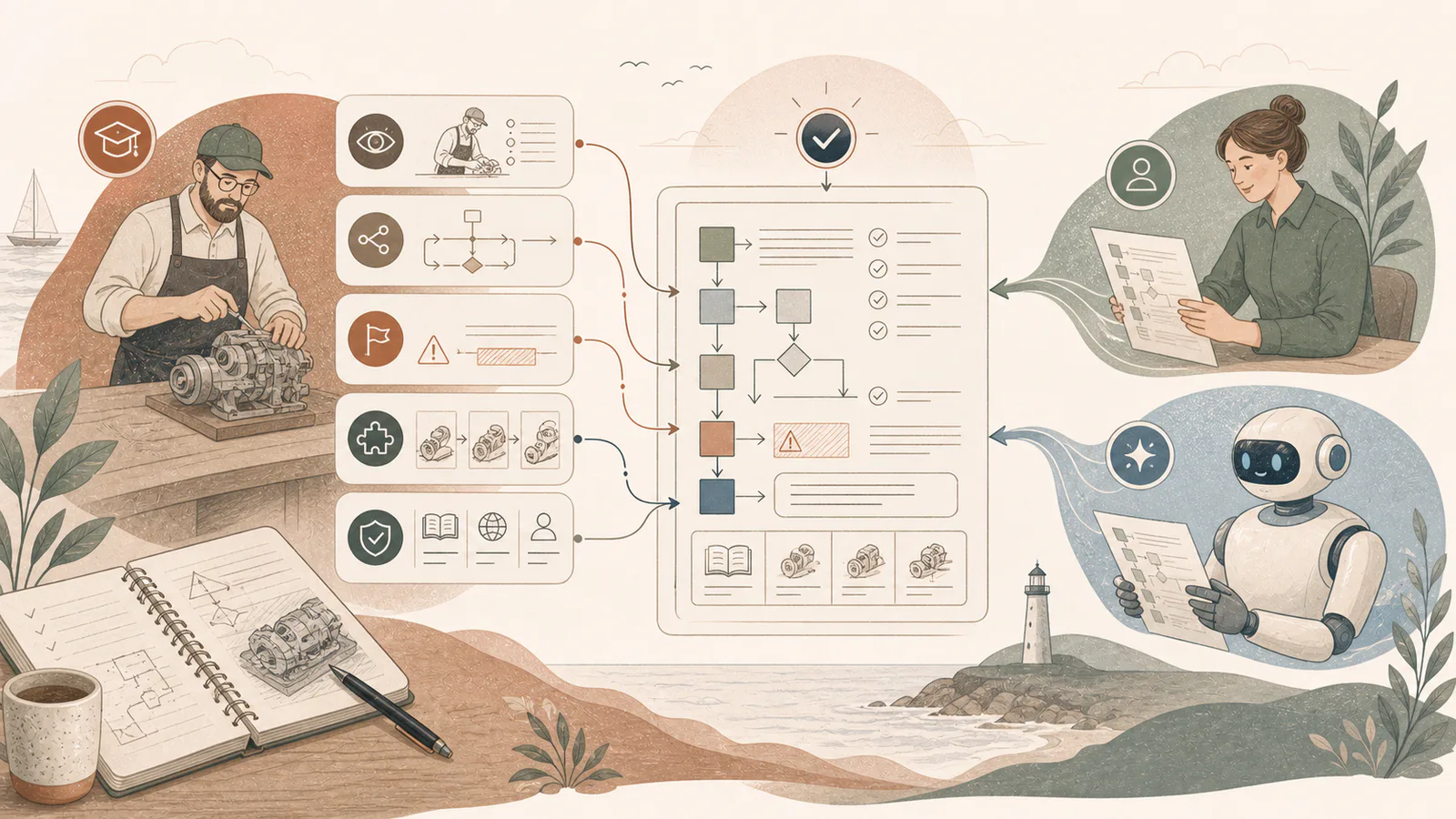
An AI-ready SOP records more than steps. It explains the goal, approved inputs, decision rules, common exceptions, evidence, output standard, and when the task must be handed to a person.
Much of the most valuable business knowledge is not in the procedure manual.
It lives in sentences like:
- “We normally do it this way, except when…”
- “You can tell this customer needs a call because…”
- “That number looks right, but always compare it with…”
- “If these two documents disagree, trust this one.”
AI makes weak documentation visible because it cannot reliably follow rules that were never recorded.
Choose one real task
Start with a task that is:
- Repeated.
- Valuable.
- Currently dependent on one or two experienced people.
- Clear enough to observe.
- Safe to document with appropriate privacy controls.
Examples include proposal preparation, enquiry triage, monthly reporting, supplier onboarding, file review, or meeting follow-up.
Observe the work, not only the explanation
Ask the expert to complete several real examples while narrating:
- What they look at first.
- Which information they trust.
- What makes them pause.
- Which shortcuts are safe.
- Which cases are unusual.
- How they know the output is finished.
People often omit familiar judgement when describing a process from memory.
Capture the decision points
A basic SOP says:
Review the enquiry and prepare a response.
An AI-ready SOP asks:
- What counts as a routine enquiry?
- Which service information is authoritative?
- What details must be confirmed?
- What must never be promised?
- Which wording signals a complaint or urgent risk?
- Who approves discounts or exceptions?
- What should happen when information is missing?
The decisions are the procedure.
Use a practical structure
Purpose
What outcome should the procedure produce, for whom, and why?
Scope
Which cases are included and excluded?
Inputs
What documents, fields, systems, or approvals are required?
Authoritative sources
Which policy, price list, database, or owner resolves uncertainty?
Steps and decision rules
Write the normal path and the important branches.
Output standard
Specify format, required content, quality, recipient, and storage.
Exceptions and escalation
List common exceptions and who decides unknown cases.
Review
Who checks the work, what they check, and what constitutes approval?
Ownership and version
Name the process owner, effective date, and next review date.
Add examples and counterexamples
Include:
- A good completed output.
- A common mistake.
- An incomplete input.
- A case that must be escalated.
- A difficult but valid exception.
Examples make abstract rules testable for both people and AI.
Use AI to structure the draft
With approved, safely handled material, ask AI to:
- Turn an expert interview into a draft outline.
- Separate steps from decision rules.
- Identify undefined terms.
- List missing inputs and owners.
- Compare the SOP with real examples.
- Convert the final procedure into a training checklist.
Do not ask it to invent missing policy.
Using only the interview and examples supplied, draft the SOP.
Mark every missing rule, owner, source, or exception as [NEEDS CONFIRMATION].
Do not fill gaps from general knowledge.
Validate with real cases
Give the draft to someone other than the expert.
Can they complete the task? Where do they stop? Which terms are ambiguous? Which judgement still lives only in the expert’s head?
Then test the same cases with the intended AI workflow and score the output.
Keep the SOP maintainable
Store one approved version. Link to source documents rather than copying large sections that will become stale. Assign an owner and review after:
- A policy change.
- A product or system change.
- A serious error.
- A new recurring exception.
- A model or automation change.
OpenAI’s guide to identifying and scaling AI use cases highlights the value of business context, examples, and workflow-specific material. Those inputs become much stronger when the underlying procedure is explicit.
Connect the SOP to the business knowledge base and project instructions. Rising Tide’s workflow setup can turn expert knowledge into a tested, reviewable AI-assisted process.