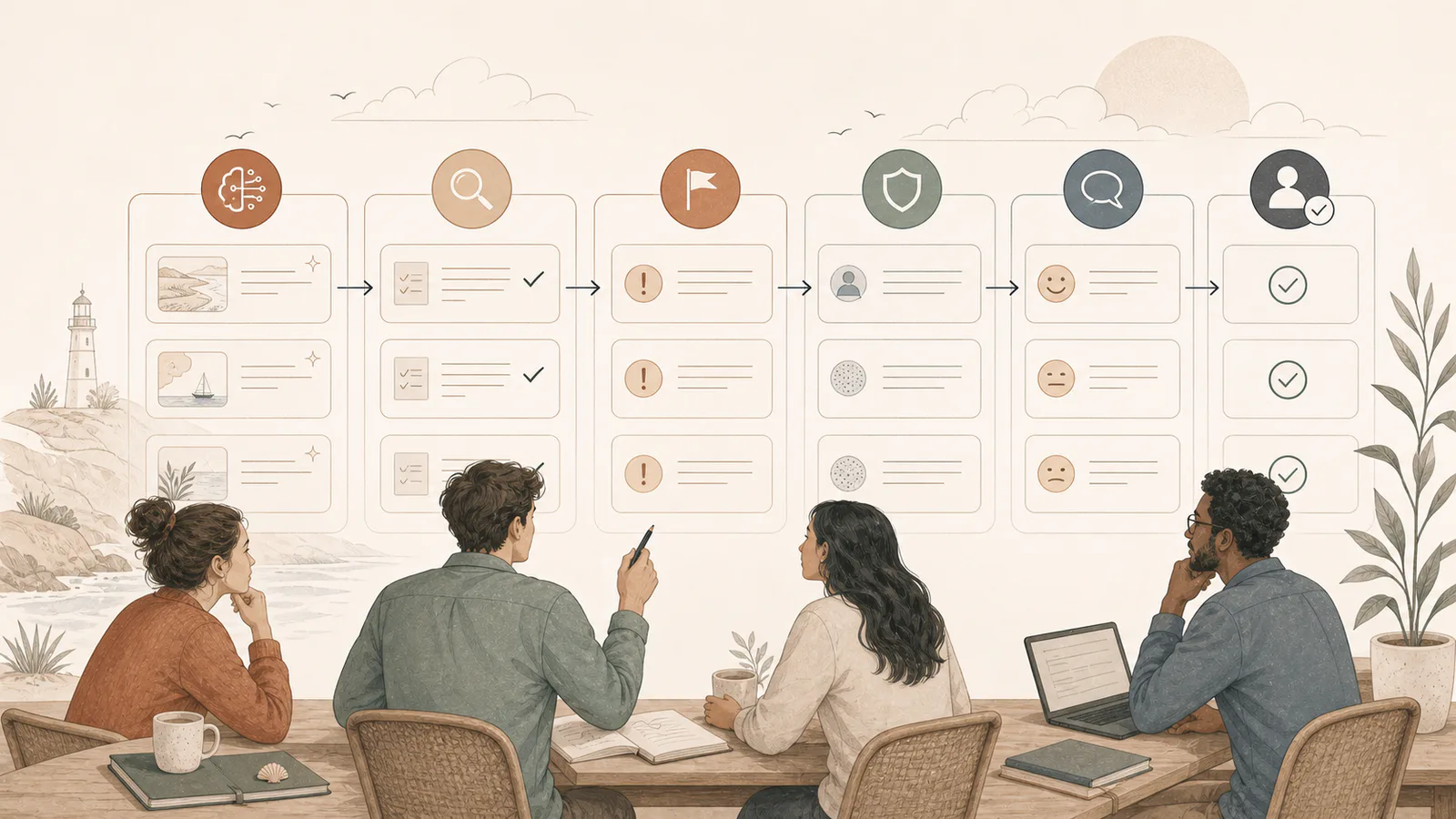
The best AI review checklist is built for one repeated task. It names the errors that matter, identifies who can approve the output, and takes less time to use than fixing a preventable mistake.
“Remember to check the AI” is not a quality process.
People need to know what to check, how carefully to check it, and when they should stop and ask someone else.
A checklist makes that visible.
Build it around one workflow
Do not begin with a universal checklist for every possible AI use.
Choose one repeated task, such as:
- Drafting a customer reply.
- Turning meeting notes into actions.
- Summarising a report.
- Preparing a proposal outline.
- Rewriting a policy into plain English.
- Extracting fields from a document.
Then collect five to ten real examples. Ask the people who already do the work where mistakes occur and what a good result must contain.
The checklist should reflect the work, not generic AI anxiety.
The six checks most teams need
1. Task check
- Did the output answer the actual request?
- Did it use the required format?
- Did it leave out a required section?
AI sometimes produces a polished answer to a slightly different task. Check alignment before editing the wording.
2. Evidence check
- Are names, dates, numbers, quotations, and claims correct?
- Can important claims be traced to the original source?
- Has anything been presented as fact when it is really an assumption?
Use the more detailed AI fact-checking process when the output contains public or consequential claims.
3. Missing-information check
- What did the model not know?
- Did it fill a gap by guessing?
- Should the task pause until more information is supplied?
A strong workflow allows “insufficient information” as a valid result.
4. Privacy and permission check
- Does the draft contain personal, confidential, commercially sensitive, or privileged information?
- Was that information allowed to enter the tool?
- Is the output going to someone authorised to receive it?
The OAIC recommends a cautious approach to personal information in generative AI and specifically advises against entering personal—particularly sensitive—information into publicly available tools as a matter of best practice. Read the OAIC guidance for commercial AI products when designing this part of the checklist.
5. Tone and commitment check
- Does it sound like the business?
- Is the tone suitable for the recipient?
- Has it promised a price, deadline, refund, outcome, or action that was not authorised?
This is where many customer-facing mistakes hide. The wording may be friendly while the commitment is wrong.
6. Approval check
- Who owns the final decision?
- Can this person send the output, or does it require a manager or specialist?
- Is there a clear escalation path?
Human review is useful only when the reviewer has the authority, context, and time to intervene.
A reusable checklist template
AI output review — [workflow name]

[ ] The output completes the requested task and format.
[ ] Names, dates, figures and claims match the source material.
[ ] Missing information is identified; no important gaps were guessed.
[ ] Personal and confidential information is handled correctly.
[ ] Tone and customer commitments are appropriate and authorised.
[ ] Required actions, owners and dates are unambiguous.
[ ] The correct person has approved the result.
Add one or two checks for the specific workflow. A proposal might need scope and pricing checks. Meeting actions might need owner and due-date checks. A policy summary might need a warning that the summary does not replace the policy.
Use examples, not only rules
Show the team:
- One acceptable output.
- One output with a subtle factual error.
- One output that makes an unauthorised commitment.
- One output that should be escalated.
Examples make the checklist concrete. They are also useful when you later evaluate whether a different prompt or model performs better.
Separate review from rewriting
Ask reviewers to check before they improve the prose.
Otherwise they can spend five minutes polishing a draft that should have been rejected because the source was incomplete.
A useful order is:
- Accept, reject, or escalate.
- Correct factual and workflow issues.
- Improve clarity and tone.
- Approve or send.
Improve the checklist when something fails
When a mistake gets through, do not immediately add “be more accurate” to the prompt.
Record:
- What failed.
- Why the current check did not catch it.
- Whether the source, prompt, model, interface, or reviewer caused the failure.
- The smallest change that would prevent recurrence.
Sometimes the answer is a new checklist item. Sometimes the task needs better source data, a clearer boundary, or a mandatory handoff.
The NIST AI Risk Management Framework treats governance and monitoring as ongoing work across the AI lifecycle. Your checklist should evolve in the same way.
Make it part of the work
Put the checklist where the output is reviewed: in the prompt template, form, project instructions, CRM stage, document template, or automation approval screen.
If it lives in a policy folder nobody opens, it will not protect the workflow.
Rising Tide’s team training and workflow setup focus on these practical review habits because safe AI use has to survive an ordinary busy week.