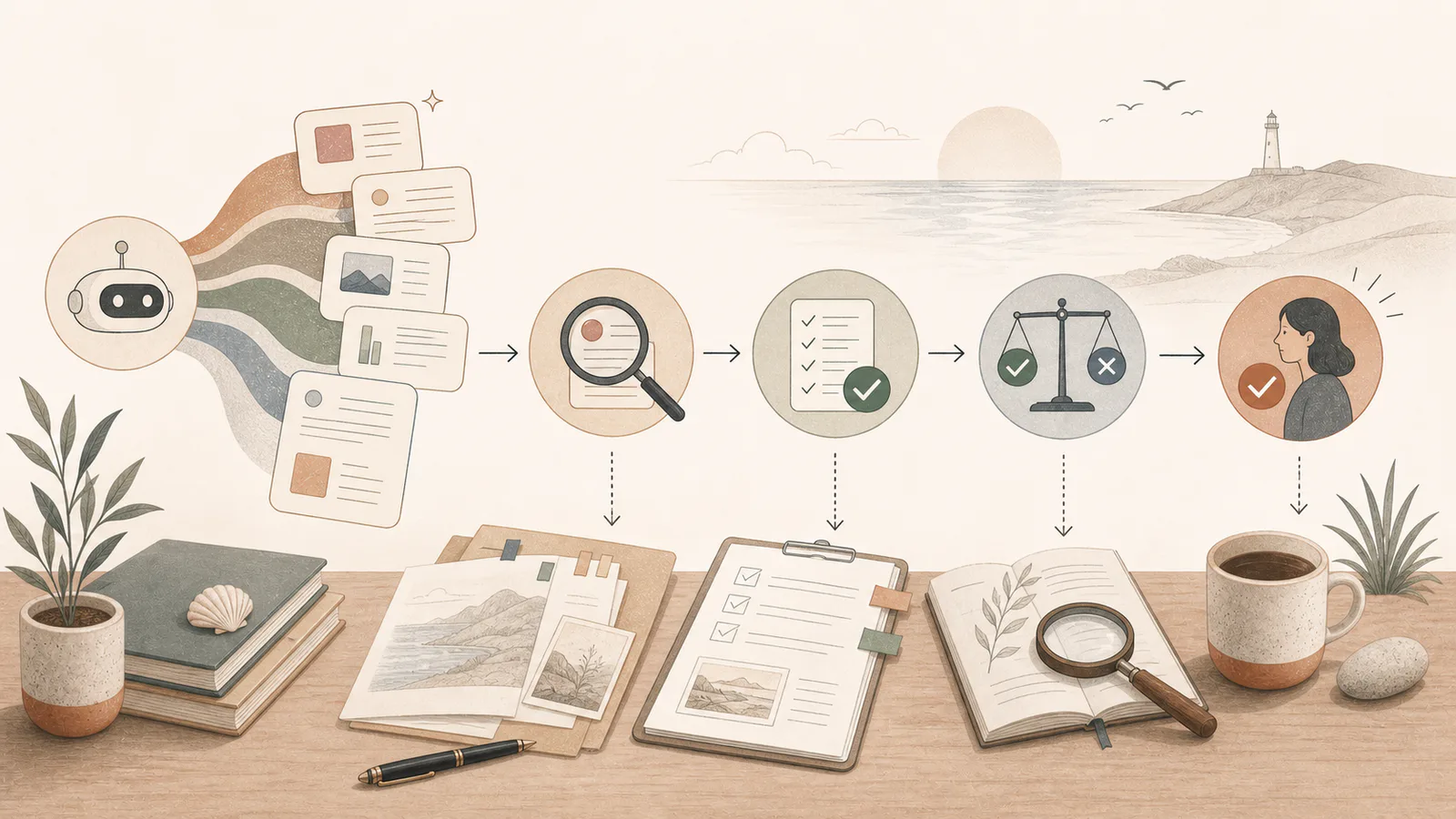
Fact-check AI output by separating its claims, locating the original evidence for each important claim, and recording what was verified. The more serious the consequence of an error, the stronger the evidence and human review should be.
AI is very good at producing language that sounds complete.
That is useful for drafting. It is not the same as being correct.
The practical problem is not that every AI answer is wrong. It is that a correct sentence and an invented sentence can arrive in the same confident tone. Your review process needs to judge the evidence, not the writing style.
Start by marking the claims
Before checking an answer, break it into claims that could be true or false.
Look for:
- Names, job titles, dates, locations, and product details.
- Numbers, percentages, prices, and calculations.
- Quotations or attributed opinions.
- Statements about laws, standards, policies, or regulations.
- Cause-and-effect claims.
- Claims about what a source supposedly says.
- Recommendations that depend on current information.
An AI-generated introduction may contain only one factual claim. A research summary may contain dozens. Marking them stops the review from becoming a vague feeling that the answer “looks right”.
Use a three-level review
Level 1: common-sense check
Ask whether the answer is internally consistent.
- Do the totals add up?
- Do the dates follow a possible sequence?
- Does the conclusion contradict an earlier paragraph?
- Has the AI quietly changed the question?
This catches obvious mistakes, but it does not prove a claim.
Level 2: source check
Open the underlying source and find the exact passage, table, dataset, policy, or product page that supports the claim.
Do not stop at a search-result snippet or another summary. Check:
- Who published it.
- When it was published or updated.
- Whether it applies to your country and situation.
- Whether the surrounding context changes the meaning.
- Whether the source is reporting evidence or merely repeating a claim.
For Australian privacy questions, for example, the Office of the Australian Information Commissioner is more authoritative than a vendor blog summarising Australian law.
Level 3: expert or operational check
Some answers need review by the person who owns the decision.
That might be an accountant checking a tax treatment, a lawyer checking a contract clause, a technician checking a safety instruction, or an operations manager confirming how work is actually performed.
AI can make the review faster. It does not inherit the professional responsibility of the reviewer.
Ask AI to make verification easier
AI can help organise the check if you give it a narrow role.
Try:
List every factual claim in this draft that a reader could reasonably challenge.
For each claim, state the type of original source that would verify it.
Do not tell me the claim is true. Do not invent sources.
You can also ask it to produce a table with:
- Claim.
- Risk if wrong.
- Source needed.
- Verification status.
- Reviewer.
This turns fact-checking into a visible workflow rather than a final read-through.
Be careful with citations generated by AI
Never assume a citation exists because it has a plausible title, author, or link.
Open it. Confirm that:
- The source exists.
- The author and title are correct.
- The source actually supports the sentence.
- The quoted words appear in the source.
- The information is still current.
The NIST Generative AI Profile identifies confident false content—often called hallucination or confabulation—as a core generative-AI risk. A citation-shaped answer does not remove that risk.
Match effort to consequence
Not every output needs the same process.
| Use | Sensible check |
|---|---|
| Brainstorming internal ideas | Sense-check and label assumptions |
| Drafting a routine email | Check names, dates, commitments, and tone |
| Publishing a blog post | Verify factual claims, links, quotes, and statistics |
| Advising a customer | Check evidence and have the accountable person approve it |
| Legal, medical, financial, safety, or employment decision | Use qualified professional review and original authoritative sources |
The review should become stronger as the potential harm increases.
Keep a short verification record
For work that matters, record:
- The final approved version.
- The sources used.
- Who reviewed it.
- The date of review.
- Any assumptions or unresolved limitations.
This is especially useful for reusable prompts and automated workflows. When an output fails later, you can see whether the issue came from the source, the instructions, the model, or the review step.
A simple final check
Before using an AI answer, ask:
- Which parts of this answer are factual claims?
- Which claims would matter if they were wrong?
- Have I opened the original evidence?
- Does the evidence apply to this situation and date?
- Does the accountable person agree with the final output?
If you cannot answer those questions, the output is not ready.
Fact-checking is one part of a broader AI review checklist. For repeatable business work, build the checks into the AI workflow setup rather than relying on memory.