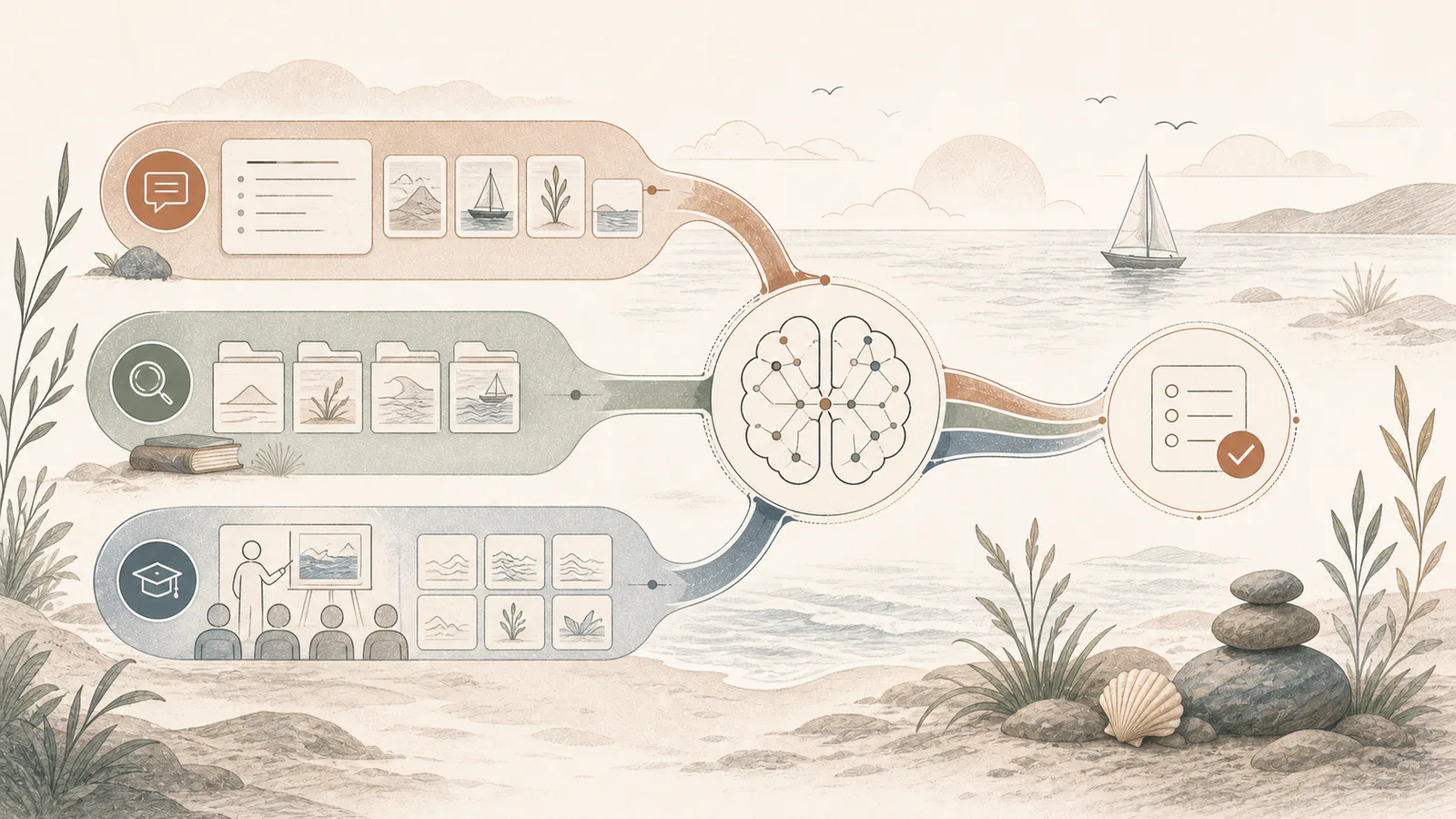
Use better instructions when the model does not understand the task. Use retrieval-augmented generation when it needs current or private source material. Consider fine-tuning when a proven, repeated task needs more consistent specialist behaviour and simpler methods have reached their limit.
When AI output disappoints, businesses often jump to the most technical solution.
The better starting point is to diagnose the failure.
Is the problem unclear instructions, missing knowledge, or inconsistent learned behaviour?
Better instructions solve task-definition problems
Improve instructions first when:
- The requested output is vague.
- The model does not know the audience or purpose.
- Required sections and constraints are missing.
- Review and escalation rules are unclear.
- Good examples have not been supplied.
A strong instruction set explains:
- The job to be done.
- The approved inputs.
- The output format.
- What good looks like.
- What not to do.
- What to do when information is missing.
- Who reviews the result.
This is inexpensive, reversible, and easy to test. See what to put in AI project instructions before building a more complex system.
Retrieval solves knowledge problems
Retrieval-augmented generation, usually shortened to RAG, finds relevant material from an approved collection and includes it in the model’s context for the current task.
Use retrieval when the answer depends on:
- Current policies or procedures.
- Product and service information.
- A private knowledge base.
- Many documents that cannot fit into every prompt.
- Evidence that should be cited.
- Content that changes often.
The source can be updated without retraining the model.
Retrieval still needs careful design
RAG is not “upload every file and trust the answer.”
Quality depends on:
- Source accuracy and ownership.
- Document structure and version control.
- How content is divided and indexed.
- Whether the right passage is retrieved.
- How conflicting sources are handled.
- Whether the answer cites the supplied evidence.
- Permissions on both source and output.
A poor knowledge base creates faster access to poor information.
Fine-tuning solves repeatable behaviour problems
Fine-tuning further trains a model on examples of the task and desired output.
It may help when:
- A high-volume classification task has stable labels.
- A specialist format must be produced consistently.
- The same behavioural pattern is difficult to specify in a prompt.
- You have many high-quality examples.
- The improvement can be measured against a baseline.
It is not usually the first solution for a handbook that changes monthly.
What fine-tuning requires
Before fine-tuning, you need:
- A stable task.
- Clean and representative examples.
- A separate evaluation set.
- Clear privacy and permission to use the data.
- A plan for model, data, and behaviour changes.
- Enough volume or value to justify the work.
If humans disagree about the correct answer, training data will encode that disagreement.
A practical decision table
| Problem | First approach |
|---|---|
| Output is poorly structured | Better instructions and examples |
| Model ignores a business rule | Clarify instructions; test rule placement and examples |
| Answer needs current policies | Retrieval from approved sources |
| Answer needs private business knowledge | Permissioned retrieval |
| Stable high-volume classification is inconsistent | Consider fine-tuning after evaluation |
| Tone varies | Examples and style guide first; fine-tuning only if scale warrants it |
| Important facts are invented | Grounding, citations, abstention, tools, and review—not fine-tuning alone |
Combine approaches when justified
A mature workflow may use:
- Clear instructions for behaviour and boundaries.
- Retrieval for current approved knowledge.
- Tools for calculations and system actions.
- Fine-tuning for a proven specialist pattern.
- Human review for risk and exceptions.
Complexity should be earned by evidence.
Test the simplest viable version
Create a representative test set and compare:
- Baseline model with a simple prompt.
- Improved instructions and examples.
- Improved instructions plus retrieval.
- Fine-tuned version only if still justified.
Measure correctness, citations, format, review time, cost, and failure modes.
OpenAI’s agent guidance recommends establishing an evaluation baseline before optimising models. That principle applies here: do not choose architecture by fashion.
Start with a clean business knowledge base and a tested AI workflow. Rising Tide’s workflow setup can help identify whether the real gap is instructions, knowledge, integration, or training.