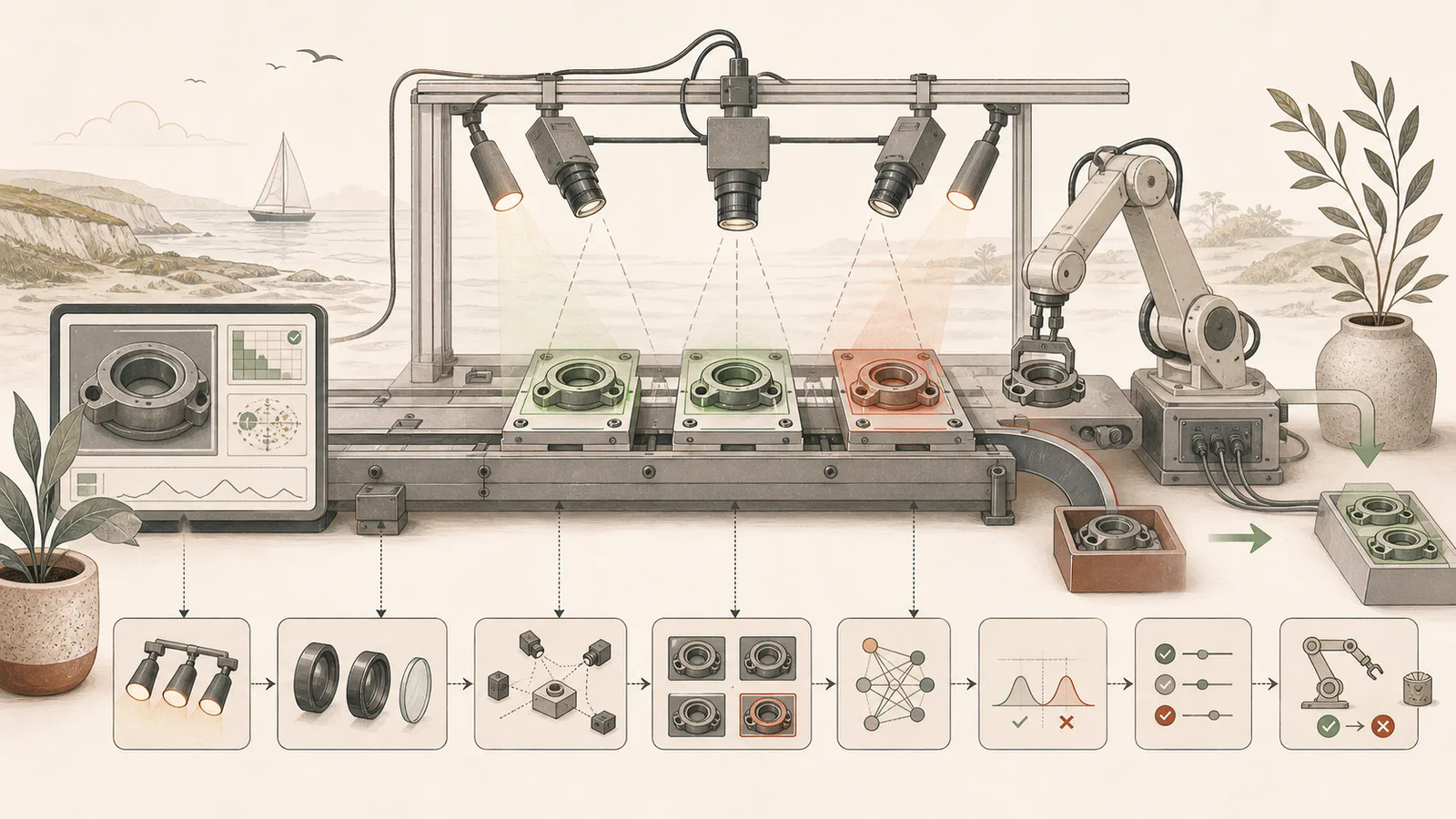
Machine vision combines cameras, lighting, optics, calibration, and software to make visual decisions in a real process. It can inspect quality, read labels, locate objects, measure dimensions, or guide a robot—but only when the image and decision are well defined.
Many physical workflows begin with a visual judgement.
- Is the label present?
- Is the part damaged?
- Is the item in the correct position?
- Has the area been cleaned?
- Is a gauge inside the acceptable range?
Machine vision turns that judgement into a measurable system.
Computer vision versus machine vision
Computer vision is the algorithmic capability to interpret images or video.
Machine vision is the operational system around it:
- Camera.
- Lens.
- Lighting.
- Trigger.
- Positioning.
- Calibration.
- Computing.
- Model or rules.
- Output to a person, machine, or robot.
- Monitoring and maintenance.
A sophisticated model cannot recover detail that the camera never captured.
Common business applications
Inspection
Detect missing components, damage, contamination, incorrect colour, seal problems, or assembly errors.
Reading
Read barcodes, labels, serial numbers, gauges, forms, or packaging information.
Counting and measuring
Count stock, measure size or spacing, estimate fill levels, or check alignment.
Location and guidance
Find an object’s position and orientation so a robot or person can act.
Monitoring
Observe zones, processes, movement, or changes over time—subject to privacy, workplace, and safety obligations.
Begin with the decision
Write:
Given this image, decide whether [specific observable condition] is present, then [specific permitted action].
Avoid “use AI to improve quality.”
Define:
- What the system must see.
- Acceptable and unacceptable examples.
- Variation in product, background, lighting, and position.
- Required speed.
- Minimum detectable defect.
- Action after a pass, fail, or uncertain result.
Control the image before improving the AI
Stabilise:
- Lighting intensity, colour, and direction.
- Camera position and vibration.
- Focus, exposure, and lens choice.
- Object distance and orientation.
- Background and reflections.
- Trigger timing.
- Cleaning and calibration.
Often the best model improvement is a better image.
Price both kinds of error
False accept
The system passes a bad item.
Possible cost: customer harm, warranty, rework later, safety risk, or reputation.
False reject
The system rejects a good item.
Possible cost: waste, delay, unnecessary inspection, or lost throughput.
Set thresholds based on these consequences and create a human-review path for uncertain cases.
Use representative images
Your test set should include:
- Normal variation.
- Rare defects.
- Different shifts and seasons.
- Dirty lenses or equipment.
- Partially hidden objects.
- Reflections and shadows.
- New packaging or suppliers.
- Borderline cases.
Do not use the same images to train, tune, and declare success.
Machine vision and robotics
A robot needs reliable perception to interact with a changing environment.
NIST’s manufacturing robotics testbed combines robot systems with vision, force sensing, tracking, simulation, and performance evaluation. That reflects the systems view businesses need: perception and action must be tested together.
Google DeepMind’s embodied-reasoning work highlights spatial understanding, multi-view reasoning, instrument reading, task planning, and success detection as important robotics capabilities. These capabilities still depend on application engineering and safety controls.
Plan for drift
Performance can change when:
- Lighting ages or moves.
- A camera shifts.
- A supplier changes material.
- Packaging is redesigned.
- Dirt accumulates.
- The process speed changes.
- The model or threshold changes.
Monitor image quality, error types, interventions, and process changes.
A sensible pilot
Choose one camera, one decision, one location, and one action.
Run the vision result beside the existing process first. Compare decisions without automatically rejecting product or controlling equipment. Expand authority only after performance is understood.
Read what embodied AI means and how to evaluate AI output. Rising Tide’s AI assessment can help shape the workflow and evidence before a specialist machine-vision engagement.